Macbeth's Netflix Queue:
American Psycho: Patrick Bateman is a character that exemplifies the appearance vs. reality theme that is so apparent in Macbeth. During the day, he's an egotistical stock broker that exudes masculinity and wants to be superior to his other colleagues. At night, however, he turns into a sadistic serial killer who enjoys sexually abusing women and killing annoying people. He is skilled at changing to different personas within minutes, so this would be appealing to Macbeth. Macbeth would definitely watch this and study up on the techniques that Patrick uses to conceal his true motives and would probably employ those techniques when talking to the rest of his comrades.

Braveheart: Macbeth would have watched this before hearing the prophecy because it contains some valuable information about his country's history. Mel Gibson stars as a loyal Scottish warrior who fights against tyranny to gain freedom from the oppressive English royalty. Macbeth would have watched this and gained inspiration to fight against the previous thane of Cawdor, who was a deceitful noble.
How to Get Away with Murder: When Macbeth would watch this, he would envision his partner, the beautiful and conniving Lady Macbeth, giving him the proper direction he needs to cover up the murder of Duncan. Similar to how Annalise Keating teaches a group of students how to remain strong under scrutiny from others after they kill a man, Lady Macbeth gives Macbeth support and direction after he kills Duncan. Macbeth might have still had some problems with coping, so he turned to this show to give him extra support.
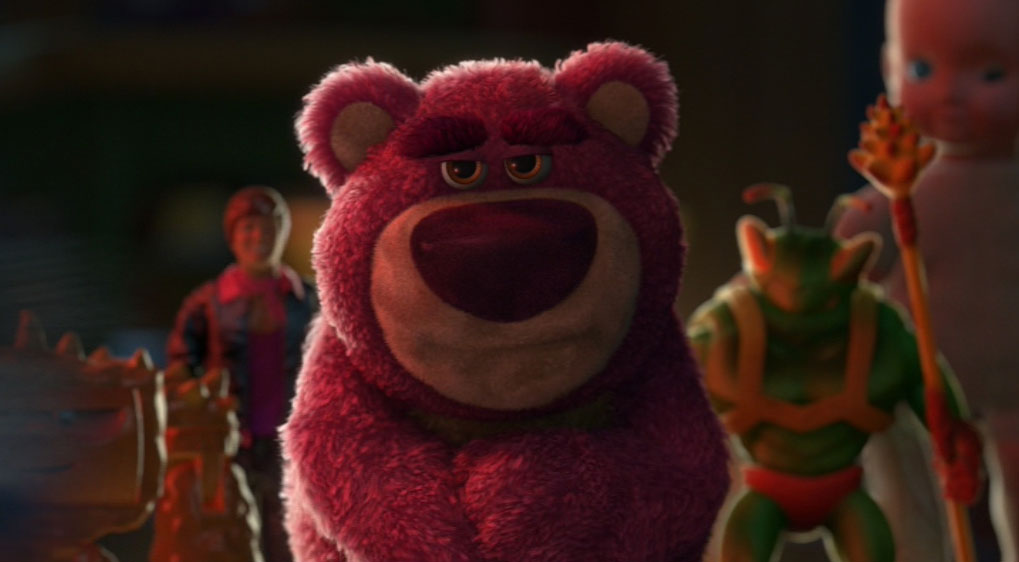
Toy Story 3: Macbeth would skip the parts with the humor and adorable aliens and study up on Lots-O' Huggin Bear (a.k.a Lotso), who is another amazing example of the appearance vs. reality theme. When he welcomes Andy's toys to the daycare center, he seems to be very appreciative and welcoming. After about 20 minutes, Macbeth and the audience would realize that Lotso is actually a pessimistic and cynical purple bear that despises kids and toys alike. Lotso is like an angry dictator, similar to how Macbeth becomes in Act 3, so that shows that maybe he wanted to emulate Lotso's powerful and commandeering characteristics.
Images:
http://www.cinemablend.com/images/news/70126/_1425464814.jpg
http://images6.fanpop.com/image/photos/32100000/Wallpaper-braveheart-32189752-1920-1080.jpg
https://pmcvariety.files.wordpress.com/2015/09/how-to-get-away-with-murder-season-2.jpg?w=670&h=377&crop=1
http://cdn.playbuzz.com/cdn/9d283d46-18b7-4743-9512-b4b5c96539ec/54109fd2-e520-43df-9c68-a13cfcc2105d.jpg
Sunday, December 13, 2015
Sunday, November 22, 2015
Blog Post #6: Macbeth's Fall of Grace
1. Why do people who are not "evil" take the first step into evil? What, for instance, is involved in taking that first step "down the primrose path to the everlasting bonfire" (Macbeth, 2.3)? What are the consequences of the individual choosing evil (particularly the internal consequences)? Use examples from the text to support your opinion.
Evil stems from internal desires and external circumstances just stir those desires up. Evil is within everyone and everyone has desires that are not acceptable in society; in the case of Macbeth, being completely selfish and wanting the throne for himself. Acting on those aspirations is what draws the line between a person's "id" and "superego". That's when the external circumstances kick in, and in the right situation, that person can just decide to let the "id" take over and let evil dominate his/her mind. In Macbeth's position, after hearing such a fulfilling and promising prophecy: "All hail, Macbeth! Hail to thee, thane of Glamis! ... thane of Cawdor! ... that shalt be king hereafter!" (Act 1, Scene 3), Macbeth realizes that it is plausible to become king. After all, these suspicious bearded ladies just said that the throne would ultimately be his, so why not? The uncertainty behind the witches and the prospect of achieving greatness is so appealing to Macbeth that his "id" of wanting more takes over and shows through his "superego". The audience does not see his evil at first, because he says "If chance will have me king, why, chance may crown me Without my stir." (Act 1, Scene 3). However, the motivation he receives from the supernatural takes root and causes him to develop a cruel plan that ultimately ruins him.
By choosing evil, an individual is ultimately dooming themselves to receive negativity in all aspects of their lives. Throughout the course of time in history and literature, the individual who chooses evil is conquered by the amazing heroic figure. In Macbeth's case, the situation is even worse. Regicide and homicide in general are not considered honorable, coming from a esteemed warrior and thane. However, Macbeth uses the prophecy and the inevitable nature of it to justify his impious actions. In Act 1, Scene 2, a captain details a battle where Macbeth was present:"For brave Macbeth—well he deserves that name— Disdaining fortune, with his brandished steel, Which smoked with bloody execution, Like valor’s minion carved out his passage". Macbeth started off as a honorable warrior who valued loyalty and honor. However, when he chooses evil, he loses this nature and his transition to darkness is even more drastic because of how honorable he used to be.
Sunday, November 8, 2015
Blog Post #5: The Cloisters Cross
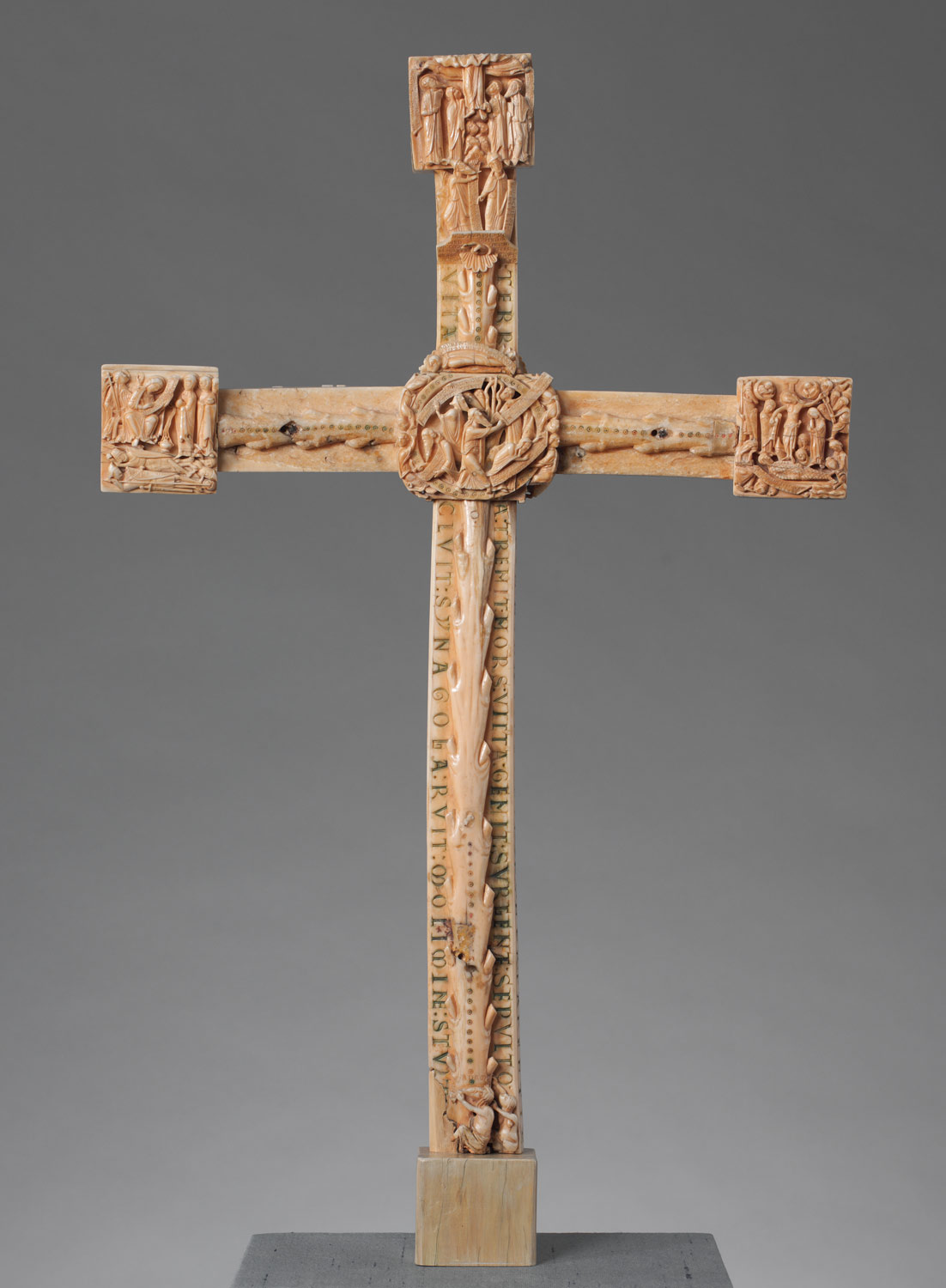
This is the Cloisters Cross, a highly intricate work of art made in the 12th century by an unknown artist (it was probably made by a skilled craftsman under supervision of someone of the Church). This cross is made up of five separate pieces of walrus tusks (also known as morse ivory) put together and this piece was designed to be held in a person's hand. Here is a great picture taken by another blogger that will help you to visualize the size of this cross. This religious piece was crafted in Eastern England, where there was a surge of building and creating anything with religious significance. This piece was made in the mid-12th century, when there was still a transition to rule under Norman invasion.
At first glance, this piece is a beautiful work that showcases the artistic ability of England at that time. Looking closer, the viewer can see the various of Latin inscriptions and the intricacy of the several figures carved into the tusks. The eye is immediately drawn to the center circle where the artist most likely placed the utmost important iconography. Then, the eye travels to the other sections of the cross, going through the Latin inscriptions and ending each part of the cross with more depictions of religious events. The medium is all the same, so the craftsman had to use depth techniques to create a clear picture and allow for the audience to understand his message. This, along with his choice to use Latin scriptures, indicates that his audience is higher class and well-educated Christians.
All of the images have some kind of religious connotation, and according to the information section under the Metropolitan's website, some of the pictures and writings are directed against Jews. This raises some questions about the ulterior purpose of this cross. With the added knowledge about the meaning of the Latin, today's audience now sees this cross as a propaganda piece against Judaism; this paints a negative picture of Christians during this time period. This piece attacks people who practice Judaism and glorifies the righteousness of Christianity. Well, recently we read a text that also attacks a religion other than Christianity and depicts Christianity as an ideal religion: our favorite epic ever, Beowulf! This highlights an interesting characteristic of people that transcends time: the tendency for people to attack an aspect of a culture that seems foreign or even barbaric to them.
I got some outside information from: https://books.google.com/books?id=5LNV5wyNnHUC&printsec=frontcover&hl=en#v=onepage&q&f=false
Sunday, October 25, 2015
Blog Post #4: Canterbury Tales and Jane Eyre
Question #3: Identify and interpret the architectural images Jane uses to denote Mr. Brocklehurst in this chapter. What is the impact of these images on the development of his character?
In paragraphs 9 and 10, Jane refers to Mr. Brocklehurst as "gaunt", a "black column" and "longer, narrower, and more rigid than ever". She also explicitly calls the man a "piece of architecture". Automatically, the readers see Mr. Brocklehurst as a looming and dark figure, which has a negative connotation to it. The readers already know that this person is not trustworthy and he is someone that the narrator does not view in a favorable light. This is what I picture based on Jane's initial description of him:
Even though this picture was drawn in South Carolina during the Civil War, you get the idea.
Later on in the passage, Jane depicts him as a hypocritical and overly strict man who continually uses religion as a flimsy justification for his various decrees. He humiliates Jane for dropping a slate on accident, and he also tells the caregiver to cut off all of the girls' hair, which explains why she is resentful towards him. This is one of the reasons she depicts him as a dark figure. Furthermore, a tall and slim building that was made in the early 1800's was unlikely to maintain its structure. Similarly, Jane might be foreshadowing at his downfall later on in the novel (I did some research, and I found out that people find out about Mr. Brocklehurst's unfair treatment of the girls and they subsequently reprimanded him for his actions).
In paragraphs 9 and 10, Jane refers to Mr. Brocklehurst as "gaunt", a "black column" and "longer, narrower, and more rigid than ever". She also explicitly calls the man a "piece of architecture". Automatically, the readers see Mr. Brocklehurst as a looming and dark figure, which has a negative connotation to it. The readers already know that this person is not trustworthy and he is someone that the narrator does not view in a favorable light. This is what I picture based on Jane's initial description of him:
![]() |
| Mr. Brocklehurst would be the building on the right with smoke coming out from the openings |
Even though this picture was drawn in South Carolina during the Civil War, you get the idea.
Later on in the passage, Jane depicts him as a hypocritical and overly strict man who continually uses religion as a flimsy justification for his various decrees. He humiliates Jane for dropping a slate on accident, and he also tells the caregiver to cut off all of the girls' hair, which explains why she is resentful towards him. This is one of the reasons she depicts him as a dark figure. Furthermore, a tall and slim building that was made in the early 1800's was unlikely to maintain its structure. Similarly, Jane might be foreshadowing at his downfall later on in the novel (I did some research, and I found out that people find out about Mr. Brocklehurst's unfair treatment of the girls and they subsequently reprimanded him for his actions).
Sunday, September 27, 2015
Blog Post #2: The Meaning of Anurupa
Names entail a lot, especially in my Bangladeshi culture. My name, Anurupa, means "atom (Anu) of silver (Rupa)" in Sanskrit. The way that I interpret my name is that Anurupa stands for something untainted and pure; if something is added or removed from a silver atom, it's not considered a silver atom anymore because it doesn't maintain that same kind of purity. I believe that my name defines me pretty well because I identify with the uniqueness of it.
Not many people have Anurupa as a name, and I view that as a strength but also as a weakness. Living in a Western society where these kinds of names are uncommon, I have gotten used to the mispronunciation and confusion that arises when someone sees my name. I still dread the first day of class when teachers call role or even when we have a substitute teacher. However, I have learned to accept this and embrace the fact that my name is unique. Whenever someone says my name is pretty, I take pride in that. All these scenarios and emotions that come with my own name is why I believe that names are a definitive part of someone's identity.
My Bangladeshi culture also factors into how I am "two" people within my family. My parents are immigrants from Bangladesh, so the culture and traditions they follow have not been that influenced by the Western world. However, being a first-generation immigrant, I have a interesting duality between American culture and Bangladeshi culture that isolates me from my parents. I identify myself as Bengali, but I have certain values and ideals that stem from an American background. That can sometimes conflicts with my parents' beliefs and it causes disagreement within our family, which I do not enjoy.
Not many people have Anurupa as a name, and I view that as a strength but also as a weakness. Living in a Western society where these kinds of names are uncommon, I have gotten used to the mispronunciation and confusion that arises when someone sees my name. I still dread the first day of class when teachers call role or even when we have a substitute teacher. However, I have learned to accept this and embrace the fact that my name is unique. Whenever someone says my name is pretty, I take pride in that. All these scenarios and emotions that come with my own name is why I believe that names are a definitive part of someone's identity.
My Bangladeshi culture also factors into how I am "two" people within my family. My parents are immigrants from Bangladesh, so the culture and traditions they follow have not been that influenced by the Western world. However, being a first-generation immigrant, I have a interesting duality between American culture and Bangladeshi culture that isolates me from my parents. I identify myself as Bengali, but I have certain values and ideals that stem from an American background. That can sometimes conflicts with my parents' beliefs and it causes disagreement within our family, which I do not enjoy.
Sunday, September 13, 2015
Blog Post #1: Wing Young Huie & Margaret Atwood Comparison
Demolition Derby, Baker, Montana, 2001
http://photos.wingyounghuie.com/asianamerica/h4aba9802#h4aba9802
This photo was taken in a rural town during a derby, where the entire town was located. The photographer meant to take pictures of the derby as well, but this image stood out because of the lone Asian American in the audience. The photographer remarks that this man and his wife were just watching; they looked and acted like they belonged there. At first glance, I thought that the photograph was just depicting a typical country scene. The crowd includes many families with children, which indicates that this derby is a community-wide gathering. However, this picture depicts the effects of generalizations on minority groups. Everyone in the background looks to be Caucasian with the exception of the Asian American. He is wearing plain clothes, and apart from his ethnicity, he could fit into the rest of the crowd with ease. This picture isolates the Asian American by centering the photo around him and making him the spotlight of the image.
This picture depicts the concept of "othering" because the layout of the photo immediately considers him as the outcast; the Asian American is in the center of the photo but there is a clear division between him and the rest of the crowd. Similarly in The Handmaid's Tale, Offred and the other handmaidens are surrounded by the rest of Gilead in everyday situation, yet the restrictions imposed on them (no eye contact with others, no conversations, etc. ) makes them feel isolated.
Subscribe to:
Comments (Atom)