Sunday, November 22, 2015
Blog Post #6: Macbeth's Fall of Grace
1. Why do people who are not "evil" take the first step into evil? What, for instance, is involved in taking that first step "down the primrose path to the everlasting bonfire" (Macbeth, 2.3)? What are the consequences of the individual choosing evil (particularly the internal consequences)? Use examples from the text to support your opinion.
Evil stems from internal desires and external circumstances just stir those desires up. Evil is within everyone and everyone has desires that are not acceptable in society; in the case of Macbeth, being completely selfish and wanting the throne for himself. Acting on those aspirations is what draws the line between a person's "id" and "superego". That's when the external circumstances kick in, and in the right situation, that person can just decide to let the "id" take over and let evil dominate his/her mind. In Macbeth's position, after hearing such a fulfilling and promising prophecy: "All hail, Macbeth! Hail to thee, thane of Glamis! ... thane of Cawdor! ... that shalt be king hereafter!" (Act 1, Scene 3), Macbeth realizes that it is plausible to become king. After all, these suspicious bearded ladies just said that the throne would ultimately be his, so why not? The uncertainty behind the witches and the prospect of achieving greatness is so appealing to Macbeth that his "id" of wanting more takes over and shows through his "superego". The audience does not see his evil at first, because he says "If chance will have me king, why, chance may crown me Without my stir." (Act 1, Scene 3). However, the motivation he receives from the supernatural takes root and causes him to develop a cruel plan that ultimately ruins him.
By choosing evil, an individual is ultimately dooming themselves to receive negativity in all aspects of their lives. Throughout the course of time in history and literature, the individual who chooses evil is conquered by the amazing heroic figure. In Macbeth's case, the situation is even worse. Regicide and homicide in general are not considered honorable, coming from a esteemed warrior and thane. However, Macbeth uses the prophecy and the inevitable nature of it to justify his impious actions. In Act 1, Scene 2, a captain details a battle where Macbeth was present:"For brave Macbeth—well he deserves that name— Disdaining fortune, with his brandished steel, Which smoked with bloody execution, Like valor’s minion carved out his passage". Macbeth started off as a honorable warrior who valued loyalty and honor. However, when he chooses evil, he loses this nature and his transition to darkness is even more drastic because of how honorable he used to be.

Sunday, November 8, 2015
Blog Post #5: The Cloisters Cross

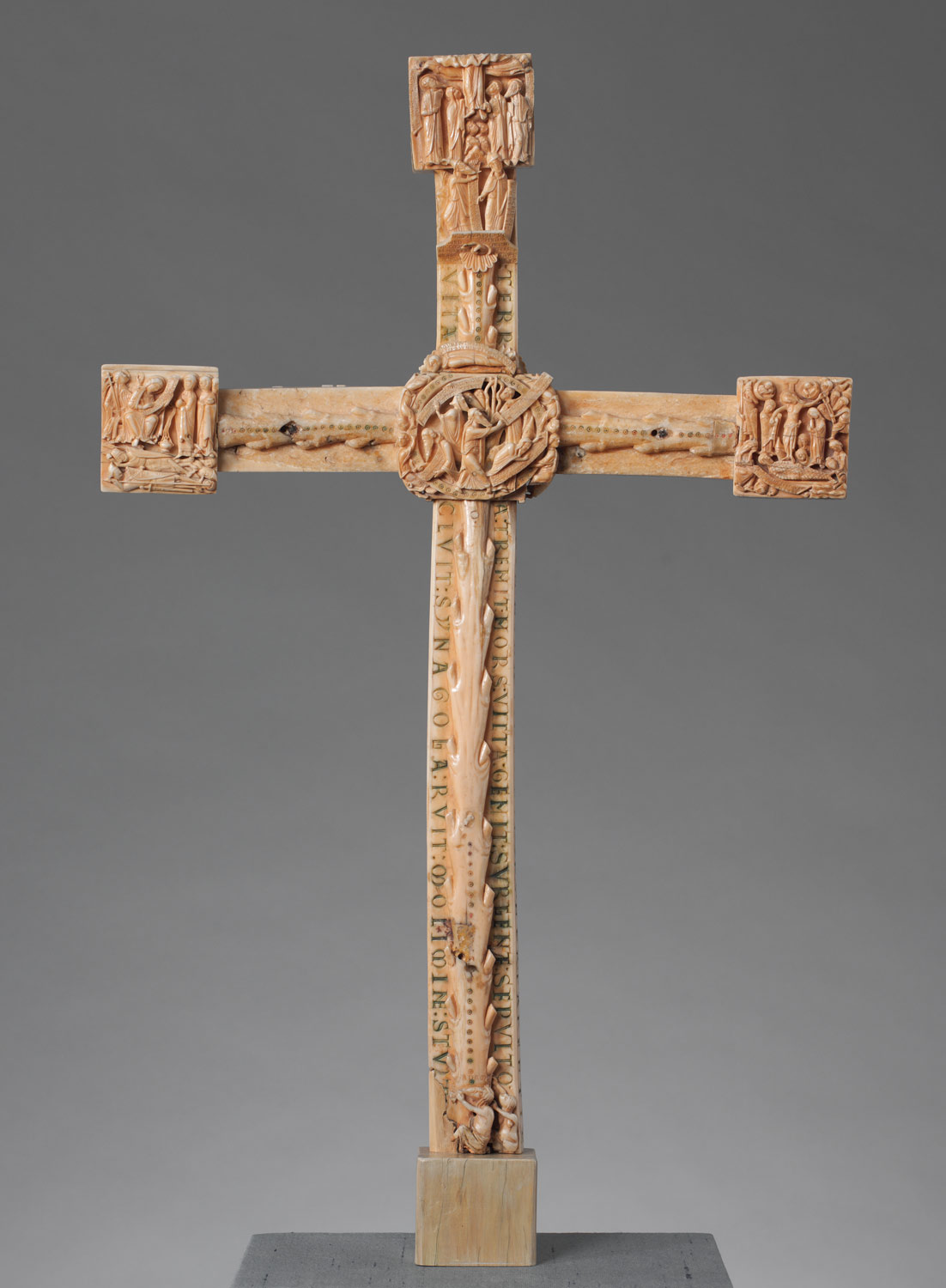
This is the Cloisters Cross, a highly intricate work of art made in the 12th century by an unknown artist (it was probably made by a skilled craftsman under supervision of someone of the Church). This cross is made up of five separate pieces of walrus tusks (also known as morse ivory) put together and this piece was designed to be held in a person's hand. Here is a great picture taken by another blogger that will help you to visualize the size of this cross. This religious piece was crafted in Eastern England, where there was a surge of building and creating anything with religious significance. This piece was made in the mid-12th century, when there was still a transition to rule under Norman invasion.

At first glance, this piece is a beautiful work that showcases the artistic ability of England at that time. Looking closer, the viewer can see the various of Latin inscriptions and the intricacy of the several figures carved into the tusks. The eye is immediately drawn to the center circle where the artist most likely placed the utmost important iconography. Then, the eye travels to the other sections of the cross, going through the Latin inscriptions and ending each part of the cross with more depictions of religious events. The medium is all the same, so the craftsman had to use depth techniques to create a clear picture and allow for the audience to understand his message. This, along with his choice to use Latin scriptures, indicates that his audience is higher class and well-educated Christians.
All of the images have some kind of religious connotation, and according to the information section under the Metropolitan's website, some of the pictures and writings are directed against Jews. This raises some questions about the ulterior purpose of this cross. With the added knowledge about the meaning of the Latin, today's audience now sees this cross as a propaganda piece against Judaism; this paints a negative picture of Christians during this time period. This piece attacks people who practice Judaism and glorifies the righteousness of Christianity. Well, recently we read a text that also attacks a religion other than Christianity and depicts Christianity as an ideal religion: our favorite epic ever, Beowulf! This highlights an interesting characteristic of people that transcends time: the tendency for people to attack an aspect of a culture that seems foreign or even barbaric to them.
All of the images have some kind of religious connotation, and according to the information section under the Metropolitan's website, some of the pictures and writings are directed against Jews. This raises some questions about the ulterior purpose of this cross. With the added knowledge about the meaning of the Latin, today's audience now sees this cross as a propaganda piece against Judaism; this paints a negative picture of Christians during this time period. This piece attacks people who practice Judaism and glorifies the righteousness of Christianity. Well, recently we read a text that also attacks a religion other than Christianity and depicts Christianity as an ideal religion: our favorite epic ever, Beowulf! This highlights an interesting characteristic of people that transcends time: the tendency for people to attack an aspect of a culture that seems foreign or even barbaric to them.
I got some outside information from: https://books.google.com/books?id=5LNV5wyNnHUC&printsec=frontcover&hl=en#v=onepage&q&f=false
Subscribe to:
Comments (Atom)